Hungary: E PM Orban pledges resistance to Magyar 'tyranny'
Hungary's former prime minister alleges that his successor has "dismantled the rule of law and eliminated checks and balances." Peter Magyar has pursued Viktor Orban
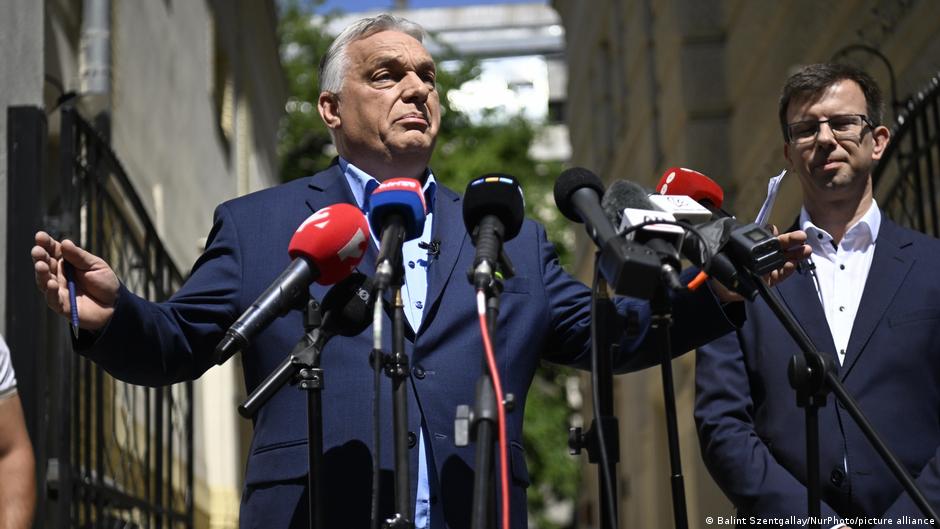
Hungary's former prime minister alleges that his successor has "dismantled the rule of law and eliminated checks and balances." Peter Magyar has pursued Viktor Orban and his allies since winning April's elections. Hungary's former Prime Minsiter Viktor Orban accused prosecutors and the new government of sham investigations into his Fidesz party on Wednesday, a day after investigators seized equipment from the party HQ in Budapest as part of a corruption probe. Hungary's longstanding leader, Orban lost April's general elections in a landslide to conservative rival Peter Magyar, himself a former Fidesz member, in a result hailed by much of Europe but not by the Trump White House. Since coming to power, Magyar has moved to dismantle what he alleges to be systemic corruption of the Orban and Fidesz era, making a host of sweeping changes. Orban, however, on Wednesday, called these measures signs of "tyranny" and said that he and his opposition party would offer "resistance" by all peaceful means. Orban chose to appear outside Fidesz's HQ a day after the buidling featured in domestic headlines for other reasons Image: Balint Szentgallay/NurPhoto/picture alliance What did Orban say? Orban's online statement late on Tuesday night, followed by his press conference outside the Fidesz HQ on Wednesday, constituted two of his strongest political statements since returning to a role as leader of the opposition in early May after 16 years in power. On Facebook, he first issued what he called a "statement of resistance" soon after his party announced that prosecutors had searched the party's HQ and seized computer servers and other materials. This is part of a corruption probe into the country's Culture Fund, which is alleged to have been a state-run payment center for Orban's inner circle and a shadow election campaign fund.
"The Culture Fund issue was just a pretext for this [search of the party headquarters]," Orban alleged, denying that there had been any wrongdoing. He said Hungary had "ceased to be a democratic state" after the new center-right government used its parliamentary supermajority to pass a constitutional amendment ending the mandates of the president and the head of the Constitutional Court — both deemed to be Orban allies. He said he and his party would "employ all peaceful means" to oppose an "illegitimate" political system. On Wednesday, outside Fidesz's base of operations, Orban said he believed Magyar was trying to hobble his party once and for all. "By yesterday, I had come to realize what this was all about," he told reporters. "What happened was that this served as a pretext to seize Fidesz's servers... This is a politically motivated legal proceeding designed to render Fidesz — which has clearly survived even this heavy political defeat and is growing stronger — legally unviable." New laws on term limits mean Orban will not be eligible to stand in Hungary's next elections, assuming they hold Image: Balint Szentgallay/NurPhoto/picture alliance How and when did Magyar win power? Peter Magyar's new party, Tisza, comfortably won general elections on April 12, claiming more than 55% of the vote against Fidesz's tally of almost 37%. Because of Hungary's first-past-the-post electoral system, Magyar now enjoys the same supermajority that Orban often did in his pomp, holding 141 of 199 seats despite having only won 55% of the votes. Fidesz holds just 52 seats. In Hungary, a two-thirds vote in parliament is needed to amend the constitution.
 The BriefWire