Did Delhi Police use excessive force? HC wants Parliament march videos preserved
The Delhi High Court on Wednesday directed Delhi Police to preserve CCTV footage, videography and all other relevant records relating to the alleged use of
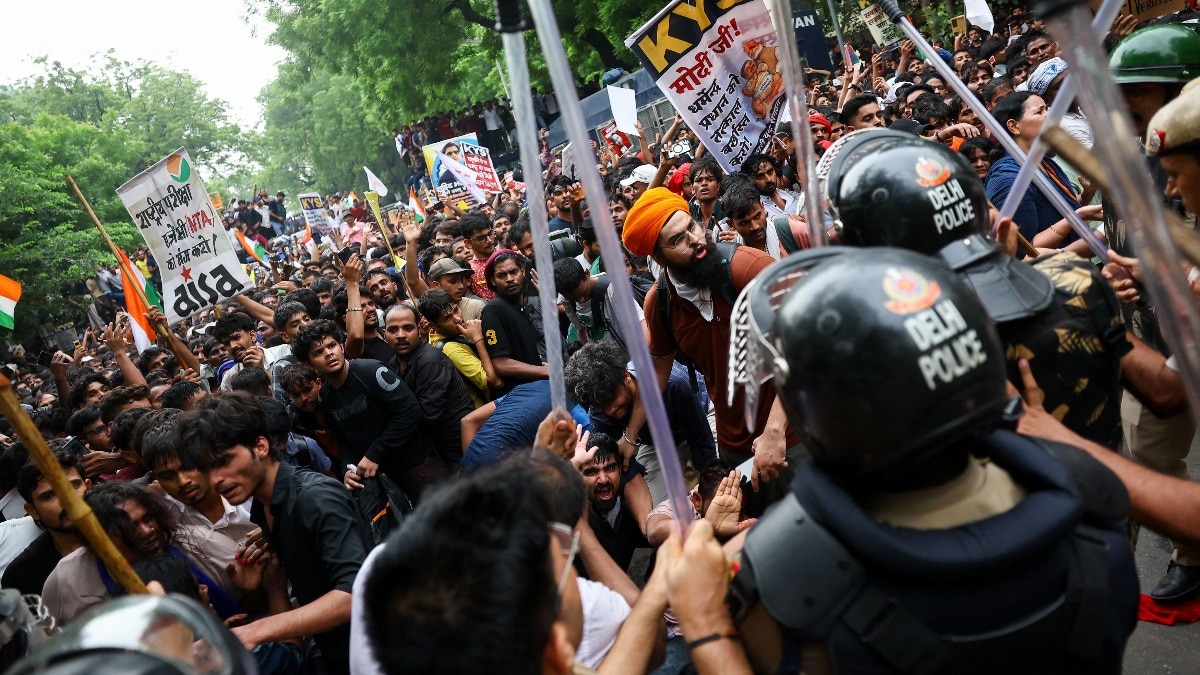
The Delhi High Court on Wednesday directed Delhi Police to preserve CCTV footage, videography and all other relevant records relating to the alleged use of excessive force against protesters during the "Chalo Sansad" march on July 20 and 21, while issuing notice to the Centre and Delhi Police on petitions alleging police excesses. A Division Bench of Chief Justice Devendra Kumar Upadhyaya and Justice Tejas Karia observed that the allegations could not be treated as a "solitary incident" and, therefore, required a formal response from the authorities instead of asking individual protesters to pursue private criminal remedies. Read Full Story "Issue notice. Let a counter affidavit on behalf of the respondents be filed in four weeks. Two weeks to the petitioners to file rejoinder. In the meantime, we direct that the relevant records in relation to the incident, including CCTV footage and videography, if any, shall be preserved in accordance with the standard operating procedure issued by the police," the bench ordered. The matter has been listed for further hearing on September 11. The Court was hearing two public interest litigations alleging that Delhi Police used disproportionate force against students and activists participating in the Cockroach Janata Party's (CJP) protest against repeated examination paper leaks and the proposed "Chalo Sansad" march towards Parliament. During the hearing, the bench questioned the Centre's argument that those alleging police excess should individually approach the police or a magistrate to seek registration of an FIR. "Had it been an isolated incident, the situation would have been different. You (police) may have been correct in asking them to go to police to lodge a private complaint.
But this is not such an (isolated) incident," the court observed. The judges further remarked that if the gathering had indeed become an unlawful assembly, the law already prescribes the procedure to deal with such situations. Referring to the broader nature of the allegations, the bench clarified that it was not examining the veracity of the claims or the authenticity of the videos at this stage, but held that the issues raised warranted a response from the authorities. Senior Advocate N Hariharan, appearing for one of the petitioners, argued that the protesters were exercising their constitutional right to peaceful assembly and that the police response amounted to "brutality of the highest order". He submitted that while the state has the authority to regulate public gatherings, any use of force must satisfy constitutional standards of fairness and proportionality. According to the petitioners, the protest at Jantar Mantar had remained peaceful until July 20, when demonstrators attempted to march towards Parliament. They alleged that police resorted to lathi-charge, tear gas, electric batons and physical assaults without issuing the mandatory warnings ordinarily required before dispersing an assembly. The petitioners also alleged that more than 90 protesters sustained injuries and claimed that women demonstrators were molested by police personnel. They sought registration of FIRs against the officers involved, constitution of a Special Investigation Team (SIT), preservation of electronic evidence, seizure of body-camera footage and protection against coercive action. Senior advocates appearing for the petitioners further alleged that several police personnel were either in plain clothes or in uniform without name tags, making identification difficult. They also claimed that videos showed officers using unauthorised weapons and disproportionate force against unarmed protesters, including women and students.
 The BriefWire