Why police personnel in plainclothes were in action during march to Parliament
When Delhi Police and the Rapid Action Force (RAF) moved to disperse protesters marching from Jantar Mantar towards Parliament on July 20, one question emerged
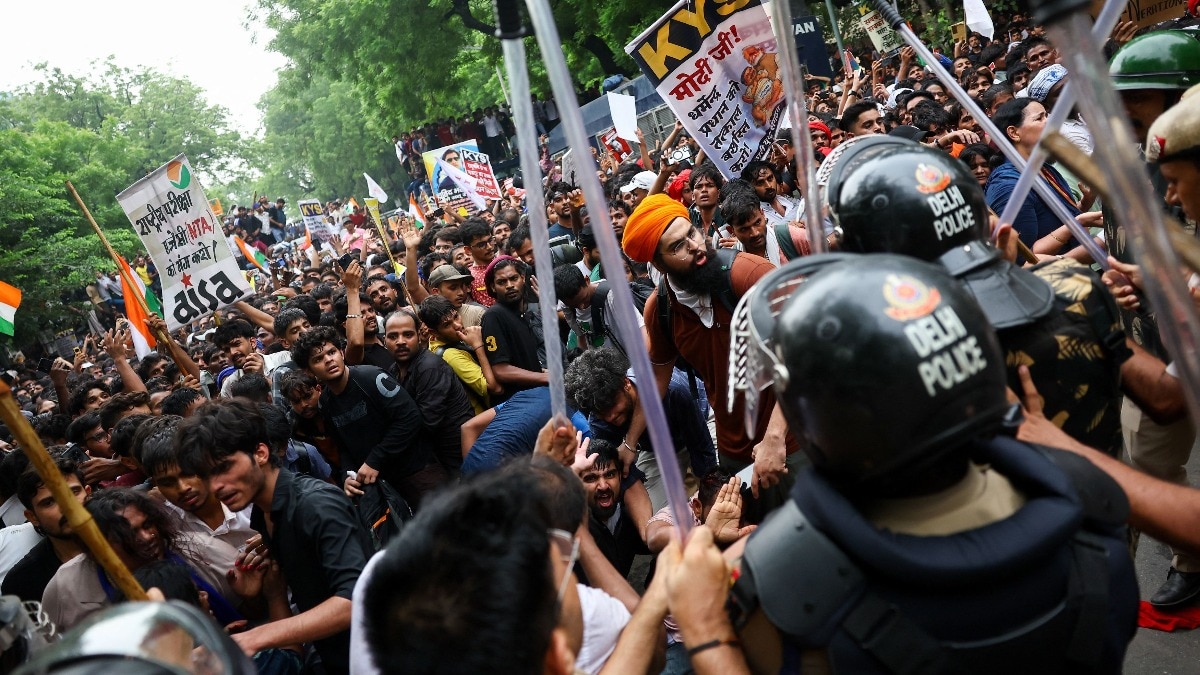
When Delhi Police and the Rapid Action Force (RAF) moved to disperse protesters marching from Jantar Mantar towards Parliament on July 20, one question emerged amid allegations of excessive force — who were the "personnel" in plainclothes, and why were several uniformed personnel not wearing name badges? The issue was highlighted by journalists at the protest site repeatedly asking personnel of the Delhi Police and the RAF why they were either out of uniform or without nameplates, but received no clear answer. An RAF personnel told India Today Digital's sister publication, The Lallantop, that they weren't wearing badges with names as "the badges could fall off during action". Read Full Story However, modern combat uniforms typically have embroidered name tapes or Velcro-backed badges designed to stay attached even during intense operations. The matter also came into focus after a reporter from The Lallantop was assaulted on camera by a man in plainclothes who was accompanied by a Delhi Police havildar. The individual was in civilian clothes and refused to identify himself or explain under what authority he was acting. Thousands of protesters tried to march to Parliament on July 20 on a call given by the Cockroach Janta Party (CJP) and activist Sonam Wangchuk. During a confrontation with the protesters, the police resorted to lathicharge and lobbed tear gas shells.
Some people in plainclothes but with polycarbonate lathis used by police were seen attacking the protesters. There are allegations of use of disproportionate force by the police. The Delhi High Court on Wednesday issued a notice to Delhi Police to preserve the video evidence of the action by its personnel on July 20. Who were those people in plainclothes? Were they police personnel? What does the law say about police personnel on duty and uniform? PLAINCLOTHES POLICEMEN ARE NOT UNUSUAL: FORMER TOP COPS Retired senior police officers from the Delhi Police and Mumbai Police told India Today Digital that deploying personnel in civilian clothes during protests is neither new nor exceptional. "Police personnel in plainclothes are deployed to gauge the mood of the crowd, get a sense of the de facto leadership and act, if needed be," a retired officer who served with Delhi Police said. He described it as a "long-standing practice", adding that such personnel are primarily used for intelligence gathering and identifying potential troublemakers before situations escalate. A former Maharashtra Director General of Police echoed that assessment. "During such unruly crowding, miscreants invariably take advantage and become part of the crowd. As noticed, there is a tendency to attack or even lynch policemen," the retired IPS officer said. "Policemen in civil clothes are part of deployment at such places.
 The BriefWire