How Rahul Gandhi launched a protest, without joining a protest
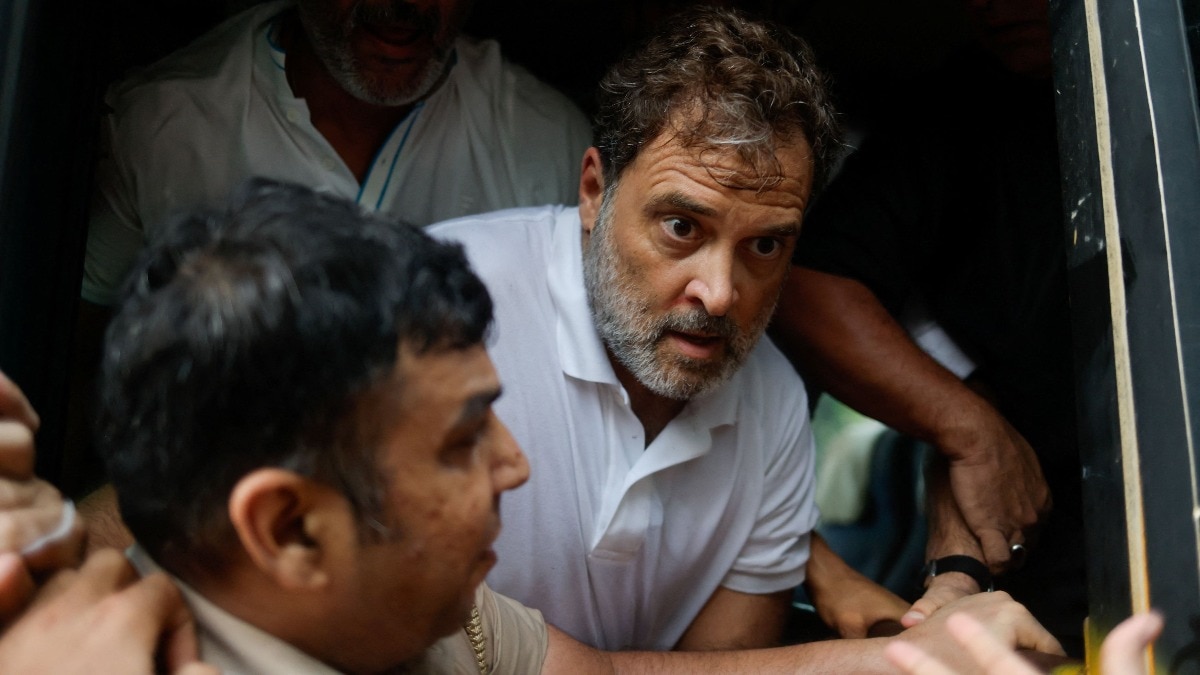
"Democracy in India is happening right now," said Rahul Gandhi as he lay down resisting cops who were trying to drag him away. With a
"Democracy in India is happening right now," said Rahul Gandhi as he lay down resisting cops who were trying to drag him away. With a sit-in protest outside the Prime Minister's official residence, the Congress leader was, finally, standing up and standing out. The image of Rahul Gandhi being forcefully carried away from 7, Lok Kalyan Marg, was among the most powerful images of the protest over the NEET-UG paper leaks and the police action on youth protesters just a day earlier. Read Full Story The party had been craving the image even as the protests over the NEET-UG paper leak went on for weeks, and Rahul Gandhi gave Congress the image on Tuesday. It was the second day of street protests. A day earlier, on July 20, protesters marched towards Parliament from Jantar Mantar after a 'Sansad Chalo' call by the Cockroach Janta Party (CJP) and activist Sonam Wangchuk. The CJP has been protesting at Jantar Mantar, demanding that Union Education Minister Dharmendra Pradhan resign over the NEET-UG issue. Instead of joining the ongoing CJP-led protest, Rahul Gandhi on Tuesday launched a parallel protest outside Prime Minister Narendra Modi's official residence at 7, Lok Kalyan Marg. By doing so, the Leader of Opposition began a protest without inheriting the one that was already on. The flash protest was an escalation in Congress's response to the growing anger over examination irregularities, which is slowly spreading across India. Accompanied by Priyanka Gandhi Vadra, Mallikarjun Kharge and other INDIA bloc leaders, Gandhi demanded Union Education Minister Dharmendra Pradhan's resignation over the NEET paper leak row while accusing the government of unleashing police excesses against student protesters. Gandhi and other Congress leaders were detained by police amid dramatic scenes, including visuals of Gandhi resisting and sustaining a minor injury, before being released a few hours later.
On Wednesday, Rahul Gandhi held a media briefing and put out three demands. Those three, he said, were students' demands. So, he is trying to lead the entire movement by voicing their demands. DID DIPKE'S PAST ASSOCIATION WITH AAP KEEP CONGRESS AWAY? The development of a parallel protest by the principal Opposition party is important because, so far, neither the BJP nor the Congress have formally mentioned the CJP — an informal youth-led movement that has stayed away from mainstream parties. The party began as a satirical social media movement, and seeing the response online, its founder, Abhijeet Dipke, returned from Boston, the US, to India. Dipke had earlier been associated with the Aam Aadmi Party (AAP). Earlier images of Dipke and AAP's Manish Sisodia emerged online. It could be one of the reasons as to why the Congress might have maintained a cautious distance from the CJP protest. Of late, however, Congress's Sewa Dal members have been assisting protesters at Jantar Mantar. Weeks without much support from political parties, the protests by the Dipke-founded CJP — centred on the issues of exam leaks, government failures, and demands for accountability — continued to appear scattered, without a single face to lead them. For over four weeks, Delhi, Bengaluru, and Mumbai saw smaller protests, but only Delhi could sustain a sit-in at Jantar Mantar led by the CJP. There wasn't much visibility and participation despite student groups like AISA, AISF, and SFI joining in. It was Sonam Wangchuk's indefinite hunger strike, which he is still continuing from a private hospital, that drew people and attention to the stir. Wangchuk's fast entered the 25th day on Wednesday. But the protests still lacked a single political face with nationwide visibility. While student organisations led demonstrations at Jantar Mantar and elsewhere, the movement remained largely decentralised, with different groups raising similar demands in different cities.
 The BriefWire