Even the well-heeled Gen Z joined the protest at Jantar Mantar. I found out why
The air at the entrance of the Cockroach Janta Party's protest site at Jantar Mantar still carried traces of tear gas, but was now mixed
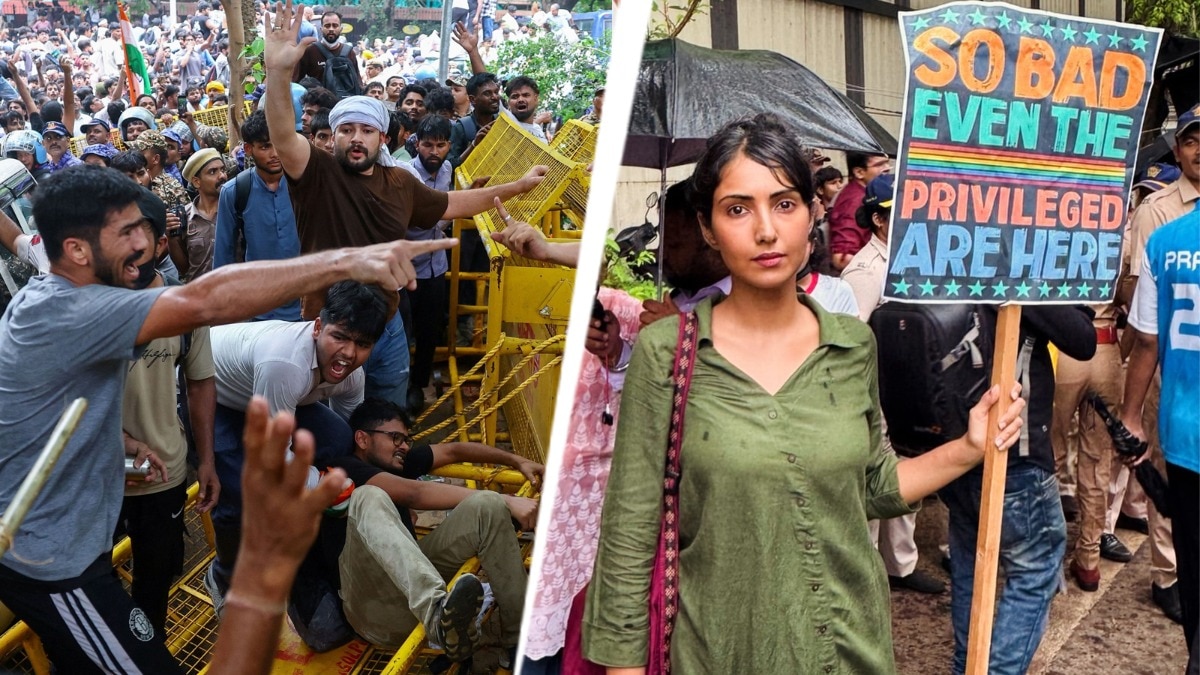
The air at the entrance of the Cockroach Janta Party's protest site at Jantar Mantar still carried traces of tear gas, but was now mixed with the smell of fresh rain. Just hours earlier, people had gathered there for the Chalo Sansad march before heading towards Parliament on Monday. Deeper in, a few hundred metres from the entrance was the stage where activist Sonam Wangchuk began his indefinite hunger strike. With the stage and tent dismantled, the place now resembled a war zone. Read Full Story Closer to the stage where Wangchuk sat, the smell changed. In some huddles of protesters, the mustiness of the crowd was cut through by the scent of cologne, layered under sweaty bodies that had stood for hours in the humid air and pouring rain. Smell tells you a lot about a place. Sometimes, it tells you about the people who occupy the place. At Jantar Mantar, it suggested that this was not a protest of only seasoned activists. Yes, the usual participants from student organisations such as NSUI, AISF and AISA were present in strength, providing structure and continuity to the protest. But as many put it aptly, "It's so bad that even the privileged are here." Metro services near the protest site remained suspended. Private vehicles were at risk of being damaged. The only way to reach the area was by autorickshaw or cab. Internet suspension across central Delhi, with only spotty Edge connectivity in the 5G era, made it impossible to book rides at fair prices through apps. Drivers capitalised on the demand. The shortest rides cost anywhere between Rs 300 and Rs 500 — rates only those with means could afford. And they did. Protests are inconvenient. Yet the people who usually limit themselves to armchair activism came to the ground.
With their latest iPhones, they shot videos and stories in succession, documenting scenes that were beyond the mainstream coverage. The crowd included school students who were headed to universities abroad. They would never have to navigate the high-stakes entrance exam system themselves, yet they had turned up to protest alongside those whose futures really depend on it. They came from families that pay lakhs in fees per semester and travel by air as routine. Better clothes. The latest iPhones. Whether we admit it or not, in India, these are the details that shape first impressions. These details added a layer to a setting where tear gas shells flew, and lathis rained, and blood wasn't a rare sight. THE PATTERN BROKE AT CJP PROTEST This participation by the privileged class is unusual. In Delhi, this was last seen during the protests against the December 16, 2012, gang rape and murder. Activist and journalist Aakar Patel notes in his book, The Anarchist Cookbook, that India's upper class — roughly the 3% that pays income ta experiences the State at few points. Its members operate in English, live in cities, and access private healthcare, education, and transport. They rarely rely on government schools, anganwadis, or the public distribution system (PDS) that supports over 80 crore people in India. Their daily lives remain largely untouched by the inefficiencies and failures that shape the majority's existence. As a result, their contact with the State is limited and often abstract. They engage with politics more as spectators than as direct stakeholders. Electoral promises on identity, nationalism, or global standing carry weight for the privileged, while everyday governance issues feel distant. Yet on this day at Jantar Mantar, that pattern broke. The situation had reached a point where even those usually removed from street action found reason to show up.
 The BriefWire