In 1879, a French postman picked up a strange stone. Over the next 33 years, he built one of Europe's most extraordinary palaces by hand
How French postman Joseph Ferdinand Cheval's 1879 stone discovery led to the Palais Idéal How postcards and newspapers inspired an extraordinary lifelong vision Inside Ferdinand
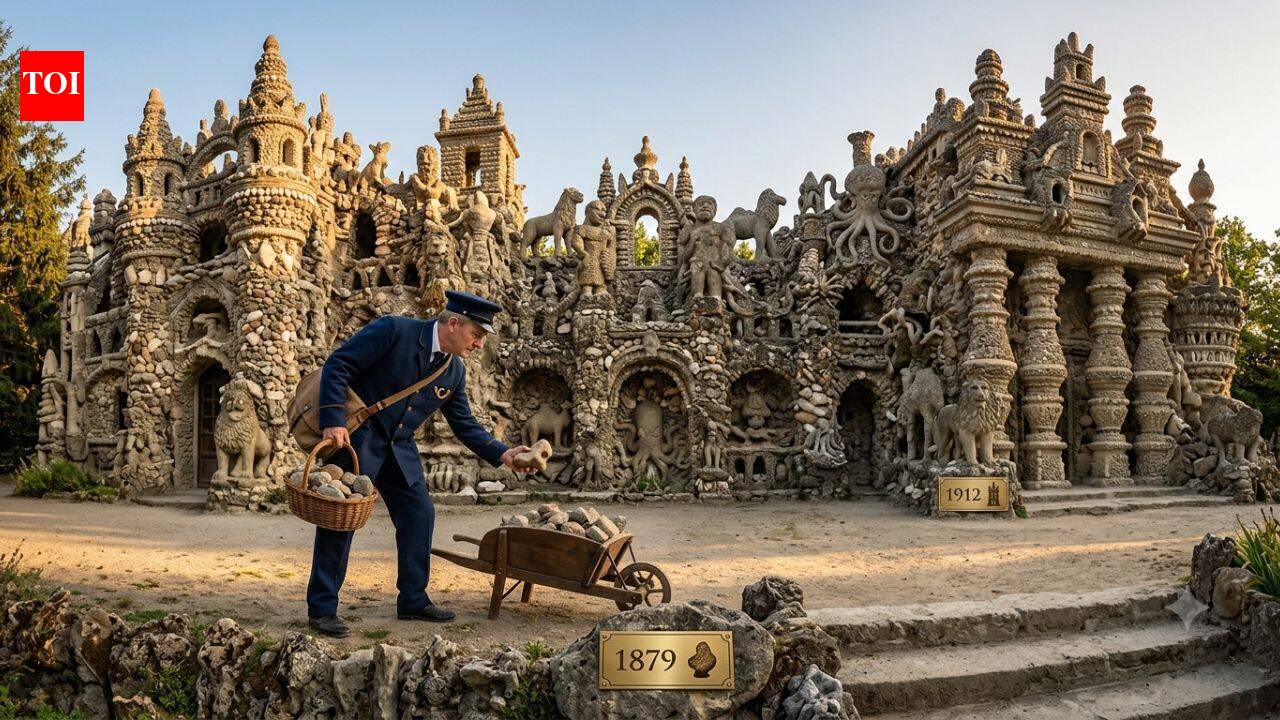
How French postman Joseph Ferdinand Cheval's 1879 stone discovery led to the Palais Idéal How postcards and newspapers inspired an extraordinary lifelong vision Inside Ferdinand Cheval's 33-year construction project Why Cheval's palace looks unlike any other building in the world How one palace became a living sculpture The hidden water system behind the Palais Idéal The monument that became his life's work Recognition that arrived much later How France finally recognised Cheval's masterpiece The lasting legacy of Ferdinand Cheval's Palais Idéal For 33 years, a French rural postman quietly spent his spare time collecting stones from the roadside, turning what began as a chance discovery into one of Europe's most unusual architectural landmarks. Joseph Ferdinand Cheval, better known as Ferdinand Cheval or Facteur Cheval, started building the Palais Idéal (Ideal Palace) in Hauterives, France, after stumbling across a strangely shaped stone during his postal route in April 1879. Without any architectural training, he worked on the monument until 1912, hauling rocks in a wheelbarrow after walking more than 30 kilometres each day delivering mail.The result was a richly decorated fantasy palace featuring temples, castles, grottoes, animals and mythological figures inspired by nature, illustrated magazines and postcards. Initially dismissed by many, the self-built monument was later embraced by leading surrealist artists and, in 1969, was designated a French historic monument by Culture Minister André Malraux, securing its place among France's most remarkable cultural landmarks.Joseph Ferdinand Cheval was 43 years old when an ordinary working day took an unexpected turn in April 1879. While delivering letters through the countryside, he stumbled over a stone whose unusual shape caught his attention.Instead of leaving it behind, he carried it home.The following day he returned to the same spot and found more stones unlike anything he had noticed before. That simple encounter became the beginning of a project he could hardly have imagined finishing. Cheval later reflected that if nature was capable of producing such remarkable forms, he could use them to build something of his own through masonry and architecture.From that point onwards, collecting stones became part of his daily routine.
His postal round stretched for more than 30 kilometres each day, giving him countless opportunities to gather material from fields, paths and riverbanks. At first he carried the stones in his pockets before relying on a wheelbarrow that became one of the enduring symbols of his work.Cheval had little reason to believe he would one day become associated with an internationally recognised monument. Born in 1836 in the small village of Charmes-sur-l'Herbasse, he grew up in a farming family with limited means. His education ended at the age of 12, after which he worked as a baker's apprentice before eventually becoming a rural postman.His profession exposed him to more than country roads. Every day he handled newspapers, illustrated magazines and postcards travelling across France. Those publications introduced distant places, unfamiliar architecture and scenes from around the world to readers who might never leave their villages.Images of temples, castles, mosques and exotic landscapes gradually found their way into his imagination. They were not copied exactly. Instead, they blended together with forms borrowed from nature, local rock formations and his own ideas, creating something that belonged entirely to him.Construction continued for an extraordinary length of time. Between 1879 and 1912, Cheval spent nearly every spare moment adding to the structure in the garden beside his home.The monument itself records the scale of that effort. An inscription carved into the building states that it required 10,000 days, 93,000 hours and 33 years of hardship. Another declares it to be "the work of one man", a reminder that the palace was completed without teams of builders or trained architects.There was no master plan laid out in advance. New sections appeared as fresh ideas emerged and as more stones were collected. Mortar, lime and shells joined the natural rock to create walls that seem to grow organically rather than follow conventional building methods.The finished monument refuses to fit neatly into any architectural category. Elements inspired by different continents sit beside one another without concern for historical accuracy or stylistic consistency.The eastern side of the palace contains one of its earliest features, a fountain known as the Source of Life, watched over by sculpted animals.
 The BriefWire