Why a 90-year-old treaty limits NATO in the Black Sea
A 90-year-old treaty still shapes the balance of power in the Black Sea. As Ukraine fights on against Russia, can NATO project power into waters
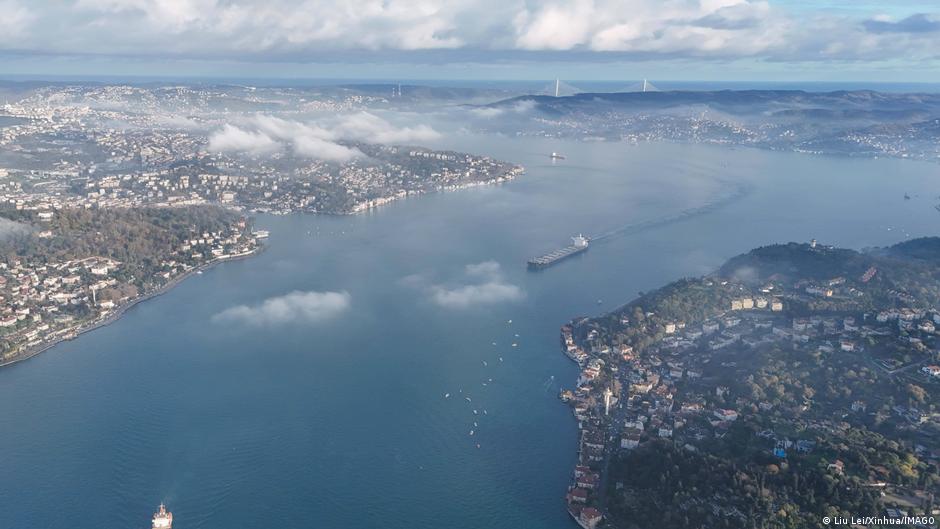
A 90-year-old treaty still shapes the balance of power in the Black Sea. As Ukraine fights on against Russia, can NATO project power into waters it can't enter freely? Now more than four years afterRussia's full-scale invasion of Ukraine, the Black Sea has become one of Europe's key security frontiers. And yet, it is currently "quite empty of warships," Thomas de Waal, a senior fellow at Carnegie Europe, told DW. This, he said, "is a bit of a paradox." To understand that paradox, we first need to need to take a closer look at the map. The Black Sea is bordered by six countries: Turkey, Bulgaria, Romania, Ukraine, Russia, and Georgia. The first three on that list are part of the North Atlantic Treaty Organization, or NATO — the other three are not. To make matters more complicated, two of the latter three are at war with each other. Narrow bottleneck to maneuver Access to the Black Sea runs through a single, narrow bottleneck. To get there, a ship coming from the Mediterranean Sea would have to pass the Dardanelles Straits and the Bosporus, which crosses through the heart of Turkey's largest metropolis Istanbul. At its narrowest point, the Bosporus is just 700 meters (0.4 miles) wide. For comparison, another critical passageway currently in the headlines is the Strait of Hormuz, which is approximately 33 kilometers (21 miles) wide at its narrowest point. It is this geographic bottleneck to the Black Sea that makes it "an economic choke point," said de Waal. "Whoever controls the Turkish Straits also controls, to some extent, trade through the Black Sea and also has an enormous military advantage." The Bosporus divides Istanbul into two sides, forming the boundary between Europe and Asia Image: Erdal3416/Depositphotos/IMAGO Russia also has a special interest in the Black Sea, according to Daria Isachenko, a visiting fellow at the German Institute for International and Security Affairs. "A strong military position in the Black Sea for Russia is not an end in itself, but also a means to advance its geopolitical ambitions beyond and also strengthen its great power status." The second part of the equation goes back to a treaty signed exactly 90 years ago. Treaty that made Turkey gatekeeper On July 20, 1936, representatives from just under a dozen countries gathered in the Swiss town of Montreux to settle a long-standing dilemma: How — and by whom — should these vital waterways be governed? They established the Montreux Convention, an agreement that essentially restored Turkey's sovereignty over the Dardanelles Strait and Bosporus.
This came after years of international oversight, following the Ottoman Empire's defeat in the First World War. Turkey reoccupied the Dardanelles Strait in July 1936, following the signing of the Montreux Convention Image: Topfoto/United Archives International/IMAGO Negotiations resulted in a document of nearly 30 pages, which set the legal framework that governs the Turkish Straits to this day. The treaty keeps the straits open to passenger and commercial traffic during peacetime — crucial for the important trade route. When it comes to military ships, Black Sea states are allowed to move their warships through the straits relatively freely. Any navy from outside the region faces restrictions on their fleet size, tonnage, and how long they are allowed to stay in the sea — no longer than 21 days during peacetime. Special rules for war During times of war, these rules become stricter. When Turkey is not part of the conflict, warships belonging to any nation involved in the fight are not allowed to pass through — a clause that has had profound consequences for the region since February 2022. Russian warships passed through the Bosporus during the Syrian civil war Image: Ozan Kose/AFP This special system of access rights keeps the Turkish government in a very powerful position. "The most privileged Black Sea state is Türkiye itself," Isachenko said. It also helps explain why NATO doesn't maintain a continuous presence in the Black Sea — unlike in other waters such as the Mediterranean or the North Sea. "For NATO, Montreux is a constraint," Isachenko pointed out. "For Türkiye, it is an instrument to keep the balance in the Black Sea." War in Ukraine tests Montreux Convention When Russia launched its full-scale invasion of Ukraine in late February 2022, the Montreux Convention arguably faced its greatest test in decades. A few days after the military operation began, Turkey invoked Article 19 of the treaty, which applies during wartime and restricts military ships belonging to countries engaged in the fight from passing through the straits. Essentially, from that point onwards, neither Russia, nor Ukraine, could freely reinforce their naval forces in the Black Sea — with one exception: warships registered to a home port in the Black Sea could return to their base. A Russian submarine passed through the Bosporus on February 13, 2022 — days before the full-scale invasion of Ukraine Image: Arife Karakum/AA/picture alliance "I think the Montreux Convention and Turkey's policy at the beginning of the war was absolutely crucial in allowing Ukraine to survive," Thomas de Waal told DW.
 The BriefWire