Vadasery’s temple jewellery: a craft caught between heritage and high gold, silver prices
Temple jewellery, a unique craft practised by the artisans of Vadasery in Nagercoil, continues to survive with its distinctive manufacturing method and rich antiquity. It
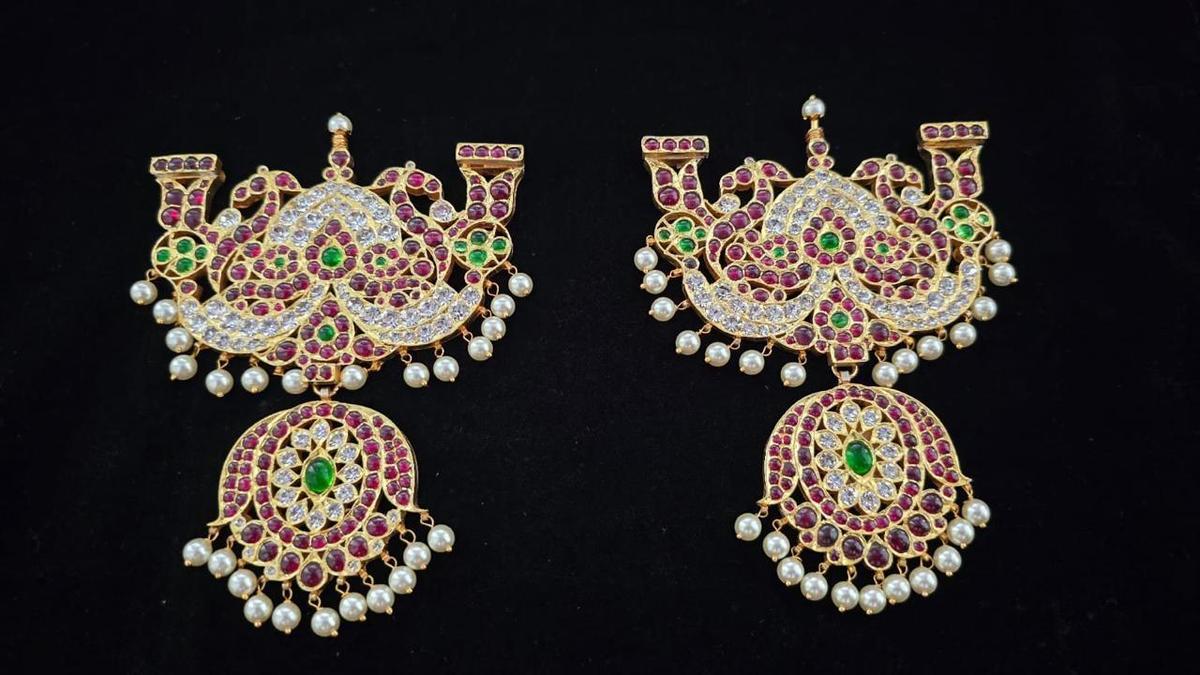
Temple jewellery, a unique craft practised by the artisans of Vadasery in Nagercoil, continues to survive with its distinctive manufacturing method and rich antiquity. It enjoys a celebrated space, especially among the classical dancers, for its intricate cuts, traditional design, and enduring quality. Each piece is handcrafted with precision. The motifs inspired by deities, nature, and animals allow the jewellery to stand out not only as an adornment but also as a living testament to heritage and cultural excellence. As gold and silver prices touch a new high every week, jewellery manufacturers and traders see it as a market concern. Notably in South India, gold and silver has never been just a commodity. Long before the advent of the global gold market and trading indices, these metals occupied sacred spaces in temple sanctums, adorning deities and worn by kings, queens, dancers, and commoners alike. Change in composition With the incessant rise in gold and silver prices, the traditional temple jewellery-makers of Vadasery are witnessing a setback in their trade. Though the product secured a Geographical Indication tag, the manufacturers feel greater public exposure is essential for its survival.
“The history of temple jewellery dates back to 9th Century AD,” says Nagalingam, who has been in this business for the past 35 years. During the early period, the temple jewel was made entirely with gold, embedded with precious stones and uncut diamonds. “Over time, owing to the rise in gold prices, the composition changed to 75% silver and 25% gold with kemp and glass stones,” he adds. He says, “The work begins with hand-made silver moulds which are filled with wax for fixing kemp stones. The piece is then finished with gold leaf and gold coating.” He recalls learning from his ancestors that the chieftains of Ramnad and Chettinad used to commission temple jewellery as offerings for deities, every time ordering from the artisans of Vadasery. “Even today, artisans from here are invited to Chennai and Bengaluru, when crown and other temple offerings are required on a large scale,” he notes. Folklorist A.K. Perumal says the business flourished when Nagercoil was under the indirect governance of the Chola kingdom. “Initially, the temple jewellery was made for deities, kings, and devadasis who were temple dancers. After the devadasi system was abolished, the craft reached a wider audience, especially classical dancers,” he explains.
However, the recent surge in gold and silver prices has resulted in a decline in orders. Around 50 families and 300 craftsmen of Vadasery depend on the temple jewellery-making, which has been their primary source of livelihood for centuries. Anand Krishnan, an artisan with over 15 years of experience, highlights the drop in demand, noting that a full jewellery set that earlier cost around ₹1.5 lakh is being sold for ₹3 lakh within a year. The ornaments in typical temple jewellery are necklace, long ‘haaram’, ‘jhumkas’, ‘vanki’, ‘odiyaanam’, ‘maattal’, and rings, and head ornaments such as ‘suriya thilakam’, ‘chandira thilakam’, ‘raakodi’, and ‘netrichutti’. “The hip belt (‘oddiyanam’) which was sold for ₹50,000 last month is being sold for ₹80,000. The rapid fluctuations in gold and silver prices have made it extremely difficult for us to calculate the cost,” he says. He adds that while a few direct orders are received, most of the finished jewellery is transported to shops in Chennai. Imitation jewellery comes in Pointing out many dancers have begun opting for imitation jewellery owing to the rising prices of the temple jewellery, Mr. Krishnan says the industry in Vadasery is struggling to recover, as artisans attempt to balance the escalating cost without compromising on quality.
 The BriefWire