Fact check: Spotting AI-generated 'historical' images
DW Fact check selected three "historical" videos that aren't real — they're AI. Could you recognize the fake? Here's how to spot it — and
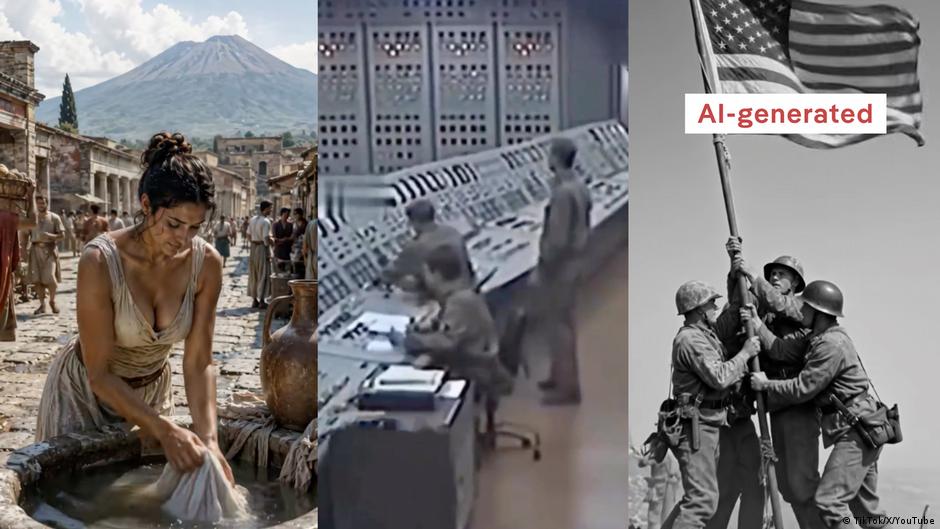
DW Fact check selected three "historical" videos that aren't real — they're AI. Could you recognize the fake? Here's how to spot it — and why it matters. In Italy's Pompeii, archaeologists have, for the first time, used artificial intelligence to reconstruct the image of a victim of the volcanic eruption in 79 C.E. AI is increasingly being used to generate "historical" images as the technology has become widely available, mostly without the consultation of experts. Roland Meyer, a media scholar at the University of Zurich, thinks the trend is no coincidence. "Through AI, it seems possible to recombine images of the past, generate synthetic images that do not exist but perhaps could have existed, and thus fill perceived or actual gaps in the archive and in the historical record," he said. "To me, however, this seems like a deceptive promise." AI generators have been known to make mistakes and "hallucinate." DW Fact check explains how to spot AI-created "historical" videos. #1: Could this video even exist? Many viral AI‑generated "historical" videos that claim to show the past blur the line between fact and entertainment. They can often be identified by simply asking whether the video could have been made. "Are we talking about a time when videos already existed, or are we talking about a time when they didn't?" asked historian and AI-specialist Sebastian Kubon. Sometimes AI-generated content is easy to spot, like in this image, which also carries a label in the bottom left corner Image: TikTok This video supposedly depicting Pompeii can be discredited on that basis alone.
It also shows clear signs of AI generation. People move in a zombie-like manner, and the woman's appearance looks far more modern than what we know of ancient Rome. The rise of AI tools has made it easier than ever to create such "historical" images and videos, but experts warn that AI is trained on existing data and will repeat its biases. "The images of the past generated by AI primarily reproduce the typical patterns, cliches and stereotypes with which that past has been depicted thus far," said Meyer. "Above all, these are images of our expectations: not a window into the past, but a mirror of our present." #2: Look for visual clues and check the source Secondly, a close look at the images themselves and their sources is helpful. In this video, the camera glides in closer to a group of soldiers holding the US flag, showing their faces as they stare into the distance. It looks more like a Hollywood film than authentic documentary footage. One soldier in the background glitches unnaturally. The watermark also gives it away: this video was produced by Veo, a generative AI tool. The video mentioned above is based on the iconic 1945 photograph of US soldiers on Iwo Jima. There is no authentic video footage of this specific moment. The historic photo of US soldiers raising the flag on the Japanese island of Iwo Jima in 1945 served as the template for an AI video.
 The BriefWire