Can your name in builder’s records lead to taxation?
What was the case? Why did the ITAT rule in favour of the taxpayer? When can Section 69A actually be invoked? What should you do
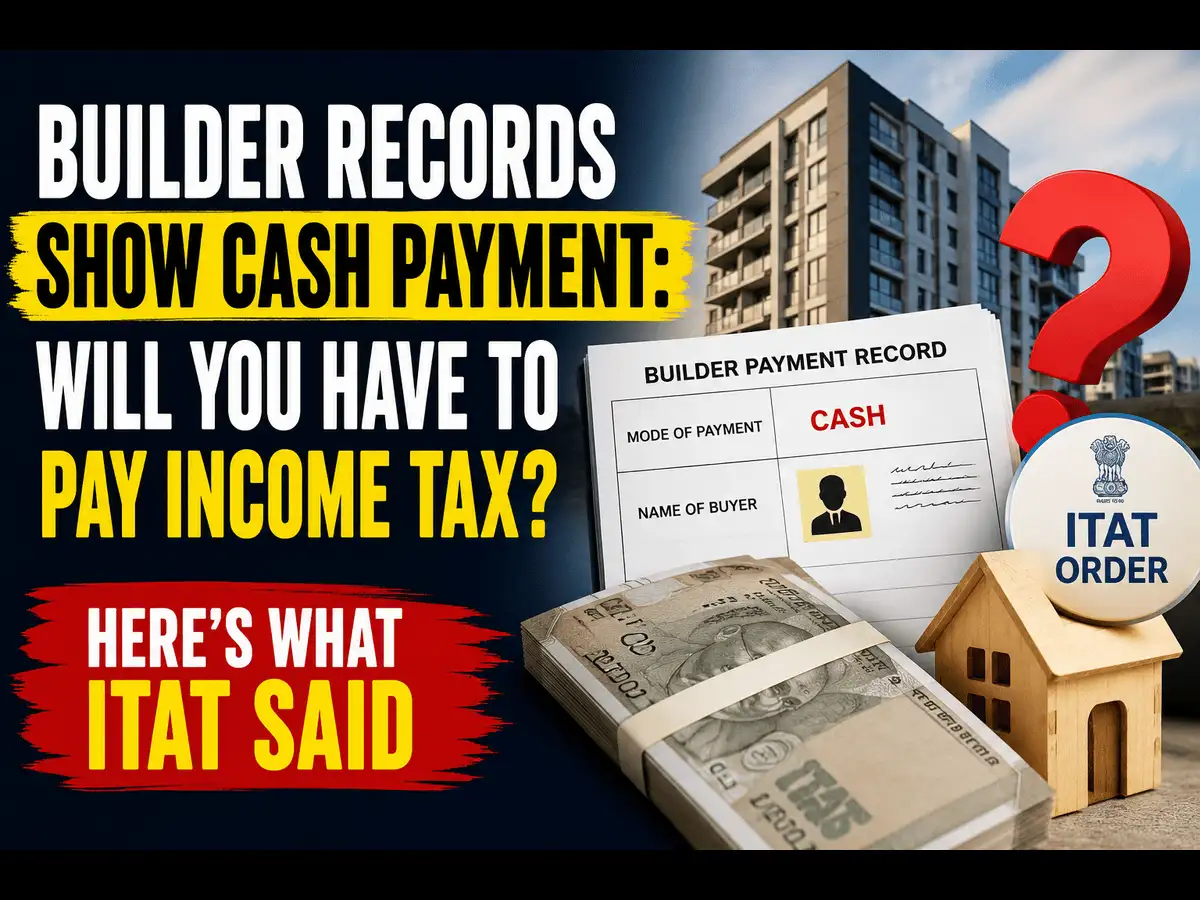
What was the case? Why did the ITAT rule in favour of the taxpayer? When can Section 69A actually be invoked? What should you do if you receive such a notice? Why is cross-examination important? Can the Income Tax Department still make additions based on third-party documents? Buying property is a significant financial undertaking.But in one such case, a buyer found themselves facing income tax notice alleging they paid "on-money" in cash, based entirely on documents recovered during a search on the builder or developer.However, in a significant ruling, the Mumbai Bench of the Income Tax Appellate Tribunal (ITAT) has held that such third-party documents, by themselves, cannot justify an addition under Section 69A of the Income-tax Act unless they are supported by independent corroborative evidence.The Tribunal also observed that the Revenue cannot ask taxpayers to prove that they did not make an undisclosed cash payment. Instead, it is for the tax department to establish the conditions necessary to levy tax.The case involved a taxpayer who had jointly purchased a commercial unit from M/s Roshni Enterprises.During a search conducted on the GNP Group in September 2021, the Income Tax Department recovered loose papers that allegedly recorded cash payments relating to various property transactions. M/s Roshni Enterprises is a partnership firm associated with the GNP Group and was among the entities covered during the Income Tax Department's search.Based on those documents, the Assessing Officer alleged that the taxpayer had paid ₹90 lakh as unaccounted "on-money" during Assessment Year 2019-20 and added the amount to his income under Section 69A.“On-Money” payment refers an unaccounted cash payment allegedly made over and above the amount recorded in the registered sale agreement.The taxpayer denied making any cash payment, submitted copies of the registered sale documents, explained that payments had been made through banking channels, and also filed an affidavit denying the allegation.
Despite this, both the Assessing Officer and the first appellate authority upheld the addition.The matter eventually reached the ITAT.The Tribunal noted that the addition rested almost entirely on loose sheets recovered from a third party during the search.It observed that there was no evidence showing that any unexplained money had been found with the taxpayer, that the taxpayer had authored or maintained the seized documents, or that any actual cash transfer had taken place.The ITAT also criticised the approach adopted by the tax authorities.Referring to the Supreme Court's decision in K.P. Varghese v. ITO, the Tribunal observed that the burden of proving taxability lies on the Revenue.“The Revenue cannot compel the assessee to prove a negative fact, namely that no on-money was paid. The burden to establish taxability lies on the Revenue. Loose sheets recovered from a third party, without corroborative evidence, cannot form the sole basis for an addition,” explains CA Aniket Kulkarni, Aniket Kulkarni & Associates.Accordingly, the Tribunal deleted the ₹90 lakh addition.Section 69A is a deeming provision that applies where the taxpayer is shown to be the owner of identifiable money, bullion, jewellery or another valuable article which is not recorded in the books, says Pallav Pradyumn Narang, Partner, CNK.Tax officers sometimes invoke Section 69A merely because a taxpayer's name appears in documents recovered from a third party, such as a builder or business associate, explains Sharanya Tripathi, Advocate at Jotwani Associates.However, ownership must be established through independent and corroborative evidence.“Where any books or documents are found during a search, the contents of such books and documents are considered as true.
 The BriefWire