Class 12 student's blog cites CBSE documents, alleges tender favouritism to Coempt
For more than a month, the Central Board of Secondary Education (CBSE) has found itself at the centre of controversy surrounding its new On-Screen Marking
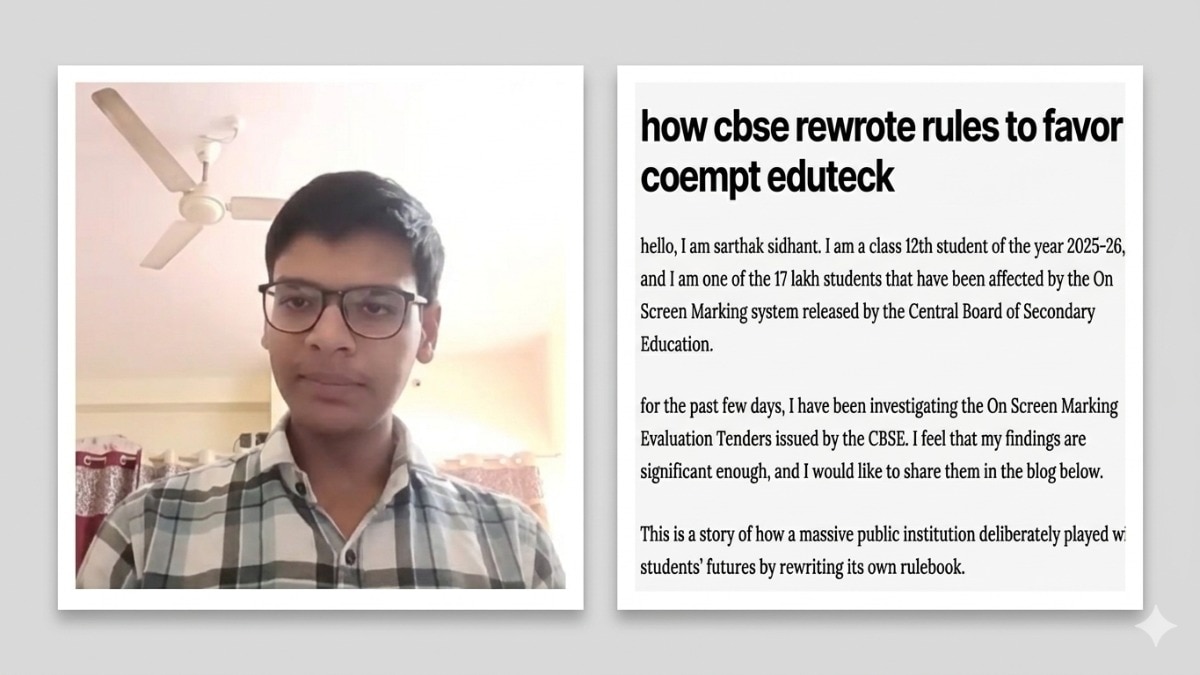
For more than a month, the Central Board of Secondary Education (CBSE) has found itself at the centre of controversy surrounding its new On-Screen Marking (OSM) system. Complaints ranging from blurred answer sheets and missing pages to alleged answer-sheet mi ups have sparked concern among students, parents, and educators across the country. As the debate intensified online, attention increasingly turned towards Coempt Eduteck, a Hyderabad-based technology company associated with parts of the digital evaluation infrastructure. Questions began emerging over how a system handling the answer sheets of millions of students could reportedly encounter issues at multiple stages of the evaluation process. Read Full Story On May 29, the controversy took a new turn when a detailed investigation by a 17-year-old Class 12 student gained widespread attention on X. The post was subsequently amplified by another user, who broke down the student's key findings in detail. This is an unbelievable piece of work by Sarthak and something that requires amplification. Let me explain what he found, in simple terms. Sarthak is a Class 12 student from the 2025-26 batch, one of the 17 lakh students whose answer sheets went through CBSE's new On-Screen Malay Krishna (@Malay4Product) May 29, 2026 The student, Sarthak, a Class 12 candidate from the 2025-26 batch and one of the approximately 17 lakh students whose answer sheets were processed through CBSE's OSM system, claims to have spent days analysing CBSE's procurement records and evaluation tenders.
According to his post, Sarthak scraped and reviewed all 576 CBSE tenders available in the public domain and tracked changes made across multiple versions of the tender related to the OSM project. The Company at the Centre Sarthak's investigation alleges that the contract for scanning and evaluating answer sheets under the OSM system was awarded to Coempt Eduteck. He further notes that Coempt Eduteck was previously known as Globarena Technologies, a company that had been associated with the Telangana Intermediate Examination controversy in 2019. During that episode, software and evaluation-related issues reportedly affected the results of thousands of students, triggering public outrage and government scrutiny. According to Sarthak, Globarena later rebranded as Coempt Eduteck. His central claim is that a series of modifications made to CBSE's tender requirements between successive bidding rounds may have altered the eligibility criteria in ways that ultimately benefited Coempt. Three Tender Rounds According to the investigation done by Sarthak, the tender process unfolded in three stages. The first tender, reportedly issued in February 2025, allegedly disappeared from the public Government e-Marketplace (GeM) records. Sarthak claims he was unable to locate it despite reviewing CBSE's tender archive. The second tender, issued in May 2025, reportedly attracted four bidders, including Tata Consultancy Services (TCS) and Coempt. According to the student's findings, all participating companies failed the technical evaluation, leading to the tender being cancelled.
A third tender was subsequently issued in August 2025, with Coempt eventually emerging as the successful bidder. Alleged Changes in Tender Conditions Sarthak's analysis identifies several modifications between the second and third versions of the tender. According to his findings Clauses disqualifying companies with histories of incomplete projects, abandoned contracts, or financial weaknesses were removed. The wording related to blacklisting was altered from " companies blacklisted earlier" to " companies currently blacklisted." The turnover requirement remained at Rs 50 crore, a threshold that Sarthak claims Coempt narrowly met. The mandatory Capability Maturity Model Integration (CMMI) certification requirement was reportedly reduced from Level 5 to Level 3. The cooling-off period for engaging retired CBSE officials was reduced from two years to one year. Experience requirements were modified from handling projects involving at least five lakh students to broader cumulative project experience criteria. Ownership requirements for data centres were replaced with provisions allowing third-party cloud infrastructure. Clauses requiring ownership or control of complete software source code were removed. A corrigendum allegedly modified provisions relating to future blacklisting by CBSE. Penalty provisions shifted focus from scanning errors and quality issues towards delays in project execution. The previously stated maximum error rate of 0.5 per cent was removed. Technical specifications for scanning infrastructure were reportedly relaxed.
Certain cybersecurity and testing requirements, including vulnerability assessment and penetration testing certifications, were allegedly altered or removed. Sarthak argues that these changes collectively lowered several technical and operational barriers that had existed in earlier versions of the tender. Security Concerns Resurface The investigation also references findings by another researcher, Nisarga, who had earlier raised concerns about potential vulnerabilities in the OSM platform. According to Sarthak, the tender modifications may help explain how such vulnerabilities could have existed within the system. He argues that changes related to security certifications, software ownership requirements, data infrastructure, and quality assurance standards may warrant further examination. While the claims made in the investigation have generated significant discussion online, neither CBSE nor Coempt Eduteck had publicly responded to the specific allegations raised in Sarthak's post at the time of writing. The controversy continues to fuel debate over transparency, accountability, and the safeguards required when large-scale public examinations transition to digital evaluation systems. Ends Published By: Karan Yadav Published On: May 30, 2026 16:17 IST
 The BriefWire