The Krishna Janmabhoomi and Shahi Idgah timeline: History, compromise & legal battle
Increasingly over the past few decades, many Hindus have insisted on reclaiming three ‘lost temples’ upon which mosques were allegedly built by Mughal emperors
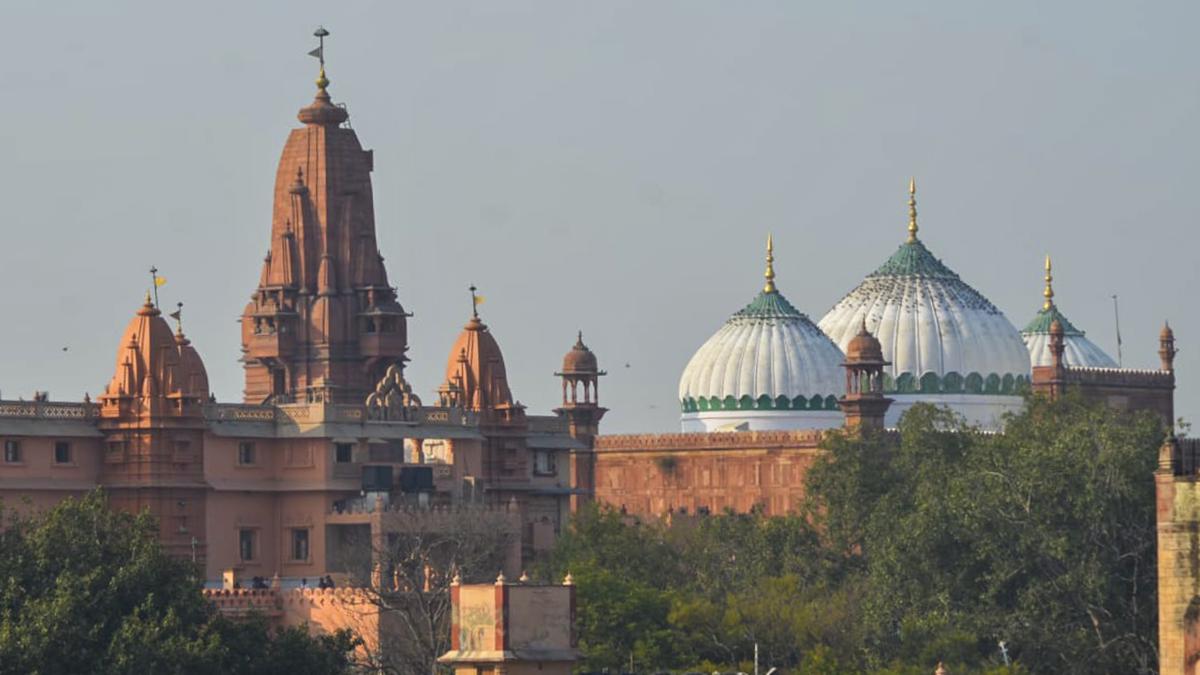
Increasingly over the past few decades, many Hindus have insisted on reclaiming three ‘lost temples’ upon which mosques were allegedly built by Mughal emperors – the Babri Masjid (Ram Janmabhoomi), the Shahi Idgah mosque (Krishna Janmabhoomi) and the Gyanvapi mosque (Vishweshwar Temple). With the construction of the Ram Temple at the site where the Babri Masjid stood in Ayodhya, movements in Mathura and Varanasi have regained fervour. Unlike the Ram Janmabhoomi movement, where Hindus sought to build a Ram Temple at the site of the demolished Babri Masjid, there already exists a temple complex named the Krishna Janmasthan Temple Complex in Mathura adjacent to the Shahi Idgah mosque. The complex comprises of three temples – the Keshavadeva temple, the Garbha Griha with an underground prison cell to mark the place Lord Krishna was said to be born and the Bhagavata Bhavan dedicated to the ancient Hindu text Srimad Bhagavata. The Shree Krishna Janmasthan Seva Sangh and Shahi Idgah committee signed an agreement in 1968 granting the temple land to the Trust and the mosque to the Shahi Idgah mosque. This agreement had relinquished the Trust’s legal claim on the mosque. However, a plea to hand over the entire land (housing both the temple and the mosque) has now been filed in court, with historical evidence being cited of a large temple built where the Shahi Idgah mosque stands. Here’s a look at the history to ‘reclaim’ Lord Krishna’s birthplace in Mathura, with a timeline of the dispute and attempts to address it. Claims of a Vasudeva temple built in 4th century American historian A W Entwistle in his book ‘Braj, Center of Krishna Pilgrimage’ suggests that a temple exists at the site of the Shahi Idgah. He claims that the oldest temple dedicated to Vasudeva (Lord Krishna) existed in the fourth century B.C at the Katra site in Mathura built during the reign of Chandragupta-II. Mathura museum curator Dr. Vasudeva Sharan Agrawala, while researching sculptures of the Kusana and Gupta period, reportedly found stones at the Katra site bearing an inscription about a ‘great temple built for Vasudeva’. Given its size and style, the stone is thought to be from the seventh or eighth century, bearing inscriptions from the western parts of North India. Invasion & destruction of Keshavadeva temple (1017-1670) The destruction of the ‘original’ Keshavadeva temple allegedly occurred in 1017 when Persian Sultan Mahmud of Ghazni invaded India, as per medieval historians Badauni and Ferishta. Entwistle claims that when the Sultan reached Mathura, he ordered the burning of ‘a temple larger than the others in the middle of the city’ to the ground. However, the temple withstood the fire, though Jain and Buddhist centres around the city did not. Excavations made by railway contractors at the Katra site in 1889 led to an Archaeological Survey of India (ASI) team discovering that the damaged temple was repaired by one Jajja in 1150, a vassal of Gahadavala King Vijayapala and was in-charge of Mathura. The temple, described as ‘brilliantly white and touching the clouds’, remained till the 15th century when Sultan Sikandar Lodi demolished Hindu, Jain and Buddhist temples in Mathura,according to Mr. Entwistle. With the fall of the Lodi dynasty in the Battle of Panipat, the Mughals began their expansion across India. Under Emperor Akbar, temples were given land and revenue grants, leading to a resurgence of temple construction. Entwistle says that a Krishna shrine named the ‘Dera Keshava Rai temple’ was built by Raja Bir Singh Deo Bundela — the ruler of Bundelkhand, during Emperor Akbar’s son Jahangir’s reign in 1618.
 The BriefWire