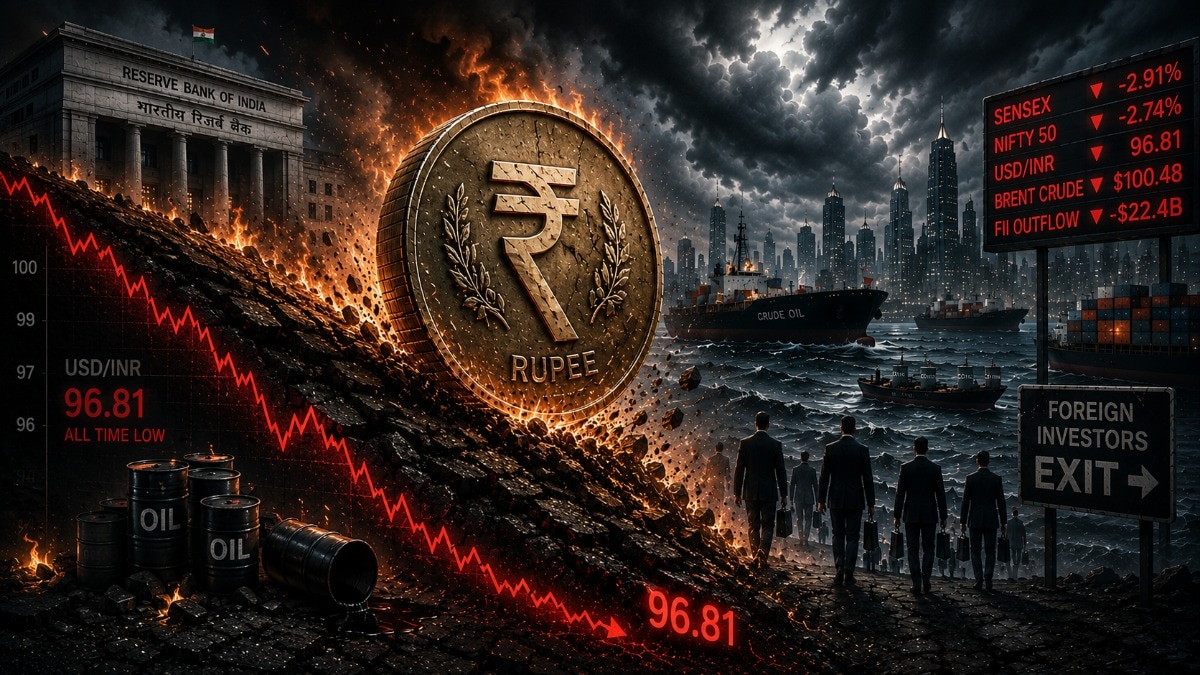
It's trousers that have levels— the retro high-rise, the classic mid-waist or the bold low-waist. For currencies, there's no fundamentally virtuous level. On a downhill roll, the Indian rupee touched a lifetime low of 96.81 against the US dollar on Wednesday, and experts believe it could slide further. While it might be a tempting thought, a falling rupee, unlike a pair of trousers, doesn't need pulling up. Not at least now. However, the rupee's weakening often becomes an emotive and political issue. Read Full Story The world is reeling due to the war in the Middle East that began on February 28 with Israeli and American airstrikes on Iran. India, which depends on energy imports, has been particularly hit. India consumes around 5.5 barrels of crude daily, and every barrel of crude is extracting additional dollars. At such times, politics takes precedence over policy. The Congress and other Opposition parties are out with a bazooka, attacking the BJP-led NDA government over the rupee that seems to be on Ozempic. It is the Reserve Bank of India (RBI) which intervenes during currency volatility, using the country's foreign exchange (forex) reserve. India's war chest is adequately stocked as of now with $697 billion. "Presently the market perception is that the RBI would let the rupee find its own level because there is an advantage for exports and also a natural barrier to imports," Madan Sabnavis, Bank of Baroda Chief Economist and author, told India Today Digital. Global trade is done in US dollars, and countries keep adequate reserves of greenbacks for any contingency. Experts are suggesting that it is best that the RBI doesn't burn valuable forex to shore up the rupee, allowing market forces to determine its value. "India's close to $700 billion in foreign exchange reserves will not run out because of higher imports. The only way reserves get depleted is if RBI decides to sell foreign exchange reserves to support the rupee," wrote Gita Gopinath, Harvard University economist and former deputy managing director of the IMF, in an op-ed in The Times of India. The piece was titled 'Let The Rupee Do Its Work'. A weaker rupee makes Indian exports competitive in the international market. But for India, which imports more than it exports, a weak rupee leads to domestic price rise. That's when the RBI steps in to control inflation. "From the time the war started, we have already seen the rupee go down 5%. So, every orange which I am importing, every chip for my mobile which I am importing, the cost is going up by 5%. So, that is going to add to inflation," explained Sabnavis. But that might have a silver lining as a weak rupee raises costs of imported goods and foreign travel, thereby acting as an austerity measure. Prime Minister Narendra Modi has urged Indians to save on fuel, avoid needless foreign trips and not buy gold to prevent draining of the much-needed dollars. HOW MUCH WILL THE INDIAN RUPEE FALL FURTHER? How far will the Rupee, already the worst-performing currency in Asia, fall further? Will it breach the psychological barrier of $100? "Honestly, I don't know how much further the rupee can fall. That's an honest answer," said Sabnavis, adding, "I thought 96 would not be breached. 94.5 to 95.5 was my level. We need to look at every rupee change in value i.e. 96, 97, 98 and so on." He said the prolonging of the war in the Middle East had set oil on fire and that would be playing a very critical role in the rupee's movement. SLIDING RUPEE COULD OFFSET PETROL, DIESEL PRICE HIKE BENEFIT FOR OMCs The price of international Brent Crude has gone up from $70-80 a barrel in February before the war in the Middle East to over $100 now. The oil shock has hit India particularly because it relies on imports to meet over 85% of its energy needs. India uses around 5.5 million barrels of oil a day, and even a $10-dollar increase per barrel means an additional load of $50 million every day. For over two months, even as global crude prices rose, India kept pump prices of fuels frozen as it conducted elections in four states and a Union Territory. However, since, India has raised petrol and diesel prices by Rs 3.90 a litre in two instalments. Though higher fuel prices are likely to fuel retail inflation, the depreciating rupee could offset the marginal relief that the hikes in fuel prices provided to India's oil marketing companies (OMCs). "Even an additional depreciation of Rs 2 in the Rupee raises the effective crude oil price significantly, pushing up landed import costs and fully offsetting gains from the current fuel price hike," according to an SBI Research report. Though the RBI had in 2025 intervened, leading to an "artificial stabilisation" of the rupee, economists don't that happening now. The idea is to let the rupee act like a shock absorber. "It looks like the RBI's intervention has been limited and calibrated," said Sabnavis, adding, that after certain interventions, "perception is that the RBI appears to be fa

 The BriefWire