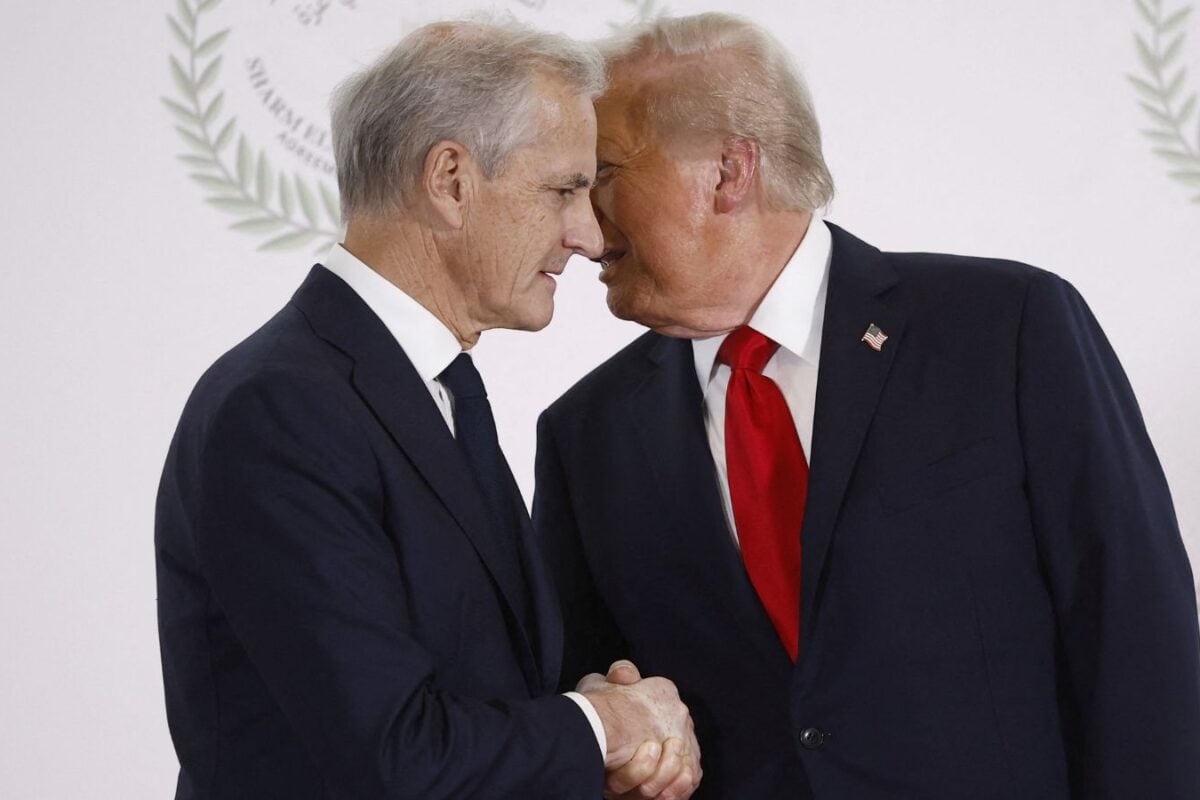
Did US Force Norway To Cancel Malaysia's $147-Million Missile Order? The Contract & Dispute Explained Written By, Last Updated: May 20, 2026, 13:36 IST What was the contract? Why the cancellation? What did Norway, Malaysia say? Did the United States (US) have a role in the cancellation? News18 explains Rapid Read U.S. President Donald Trump with Norway's Prime Minister Jonas Gahr Store. (REUTERS File) In what has triggered a major geopolitical row, Norway has abruptly revoked the export license to cancel Malaysia’s €124 million ($147 million) Naval Strike Missile (NSM) order. What was the contract? Why the cancellation? What did Norway, Malaysia say? Did the United States (US) have a role in the cancellation? The contract The original contract was signed in 2018 with Norwegian defense firm Kongsberg Defence & Aerospace to supply advanced anti-ship missiles. The weapon systems were meant to arm the Royal Malaysian Navy’s new class of Littoral Combat Ships (LCS) as part of its long-term naval modernization program. Norway’s Ministry of Foreign Affairs explained that a dramatically altered global security landscape forced them to tighten domestic export control laws. Under the updated regulations, Norway is limiting its most sensitive military technologies exclusively to NATO allies and closest partners, according to AP and Reuters. What did Malaysia claim? Malaysian Defense Minister Mohamad Khaled Nordin revealed that Malaysia had already paid roughly 95% (€126 million / US$146.66 million) of the contract value before Oslo unilaterally pulled the plug. On May 19, Malaysia officially issued a notice of demand seeking more than US$251 million (RM1 billion) in compensation from Kongsberg. Malaysian Prime Minister Anwar Ibrahim strongly protested the unilateral move, stating that contracts are “not confetti" and that the decision damages trust in European defence suppliers, according to Reuters. Malaysia’s compensation request is designed to cover both direct and indirect losses stemming from the breached agreement Direct costs: Recouping the ~95% upfront contract payments already transferred to Kongsberg. Indirect costs: Stripping out and dismantling missile-mounting hardware already built into the hulls of the ships. Structural rework: Redesigning and altering the physical framework of the combat ships to fit a replacement missile system. Operational costs: Expenses wasted on re-training Royal Malaysian Navy personnel who were prepared for the NSM system. Why the cancellation is bad news for Malaysia The Royal Malaysian Navy’s (RMN) flagship Littoral Combat Ships (LCS) will now launch without their primary offensive capabilities. Using a “fitted for but not with" approach means the multi-billion dollar vessels are structurally ready but operationally weaponless in frontline zones like the South China Sea. This cancellation disrupts Malaysia’s long-delayed “15-to-5" Naval Transformation Program, leaving a critical gap in the country’s maritime defense capabilities, say experts. What was the political fallout? The move caused severe friction between the two nations, sparking a heated diplomatic backlash. Malaysian Prime Minister Anwar Ibrahim strongly condemned the action, warning that contracts are not “confetti to be scattered in a capricious manner" and stating that European defense suppliers risk losing all credibility as reliable strategic partners. Analysts noted that the sudden cancellation leaves Malaysia’s multi-billion dollar frontline warships without their primary combat capability, severely undermining the nation’s naval readiness amid rising maritime tensions in the South China Sea. Some geopolitical observers have even raised suspicions that external pressure, potentially from the United States, played a underlying role in forcing Norway’s hand. Did US have a role in it? Can it control foreign arms sales? The United States controls foreign arms sales through a legal mechanism known as the International Traffic in Arms Regulations (ITAR), which grants Washington a legal veto over any weapon system containing American-made components, regardless of which sovereign state manufactures or sells it While a transaction may occur between two sovereign nations, the presence of even a single US-origin microchip, software code, or bolt subjects the entire system to US re-export controls. How does ITAR work? The mechanism of US extraterritorial jurisdiction relies on three core legal and technical levers ITAR regulations dictate that if a foreign-made weapon contains any US-prioritized components, the entire weapon system is legally treated as an American product for export purposes. Foreign buyers must sign End-User Monitoring (EUM) agreements. This grants US inspectors the right to physically audit the weapons and deny transfer to third parties. Modern defense systems rely heavily on US-dominated supply chains for specialized items, including semiconductors, advanced composite materials, and global positioni

 The BriefWire