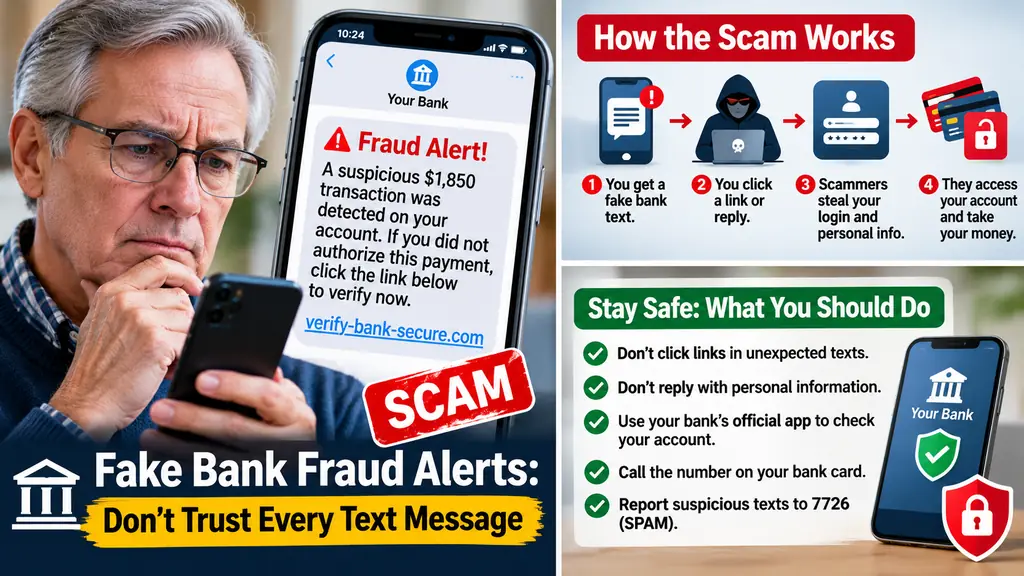
Fake Bank Fraud Alerts: Don't Trust Every Text Message
Imagine receiving a text message that appears to come from your bank:
"URGENT: A suspicious $1,850 transaction was detected on your account. If you did not authorize this payment, reply YES or call our fraud department immediately."
You may immediately worry that someone has accessed your bank account. You might reply to the message or call the number provided because you want to protect your money.
But what if the message is fake?
Scammers across the United States are impersonating banks and sending fraudulent security alerts to steal customers' money and personal information. These messages often look like genuine bank notifications and use familiar bank names, logos, and professional language.
The Federal Trade Commission (FTC) has identified fake bank fraud alerts as one of the most commonly reported types of text message scams. In its analysis of consumer reports from 2022, bank impersonation was the leading text-message scam category. The FTC also reported that the median individual loss from these bank impersonation scams was $3,000 that year.
This type of fraud is commonly known as a bank impersonation scam, fake bank fraud alert, or smishing scam.
Here's how these criminals operate, how to recognize suspicious messages, and what to do if you receive one.
1. What Is a Fake Bank Fraud Alert Scam?
A fake bank fraud alert is a fraudulent text message designed to look like a security notification from your bank.
The message may claim that:
-
Someone made an unusual purchase using your debit card.
-
A large transfer was attempted from your checking account.
-
Your online banking account has been temporarily locked.
-
Your account has suspicious login activity.
-
Your bank needs you to verify a transaction.
-
Your debit card will be blocked unless you respond.
The message usually creates a sense of urgency. It wants you to react before you have time to check whether the alert is genuine.
Scammers may ask you to click a link, reply to the text, or call a phone number. These actions can connect you directly to criminals pretending to work in your bank's fraud department.
Their goal is to obtain your banking credentials, verification codes, personal information, or access to your money.
2. How Do Fake Bank Text Message Scams Work?
These scams often involve several steps.
Step 1: You receive a fake security alert
A text arrives claiming to be from a familiar financial institution. It may mention a suspicious purchase or an unfamiliar transaction.
For example:
"Bank Security Alert: A $2,450 payment was attempted using your debit card. Reply YES if authorized or NO if unauthorized."
Step 2: You respond to the message
If you reply, the scammer knows your phone number is active and that you may be concerned about the supposed transaction.
Some messages direct you to call a phone number instead.
Step 3: A fake bank representative contacts you
Someone calls and claims to be from your bank's fraud prevention team.
They may know your name, phone number, or even some account information. This can make the call seem genuine.
However, criminals can obtain personal information from data breaches, public records, and other sources.
Step 4: They ask for sensitive information
The fake representative may request:
-
Online banking username and password
-
Debit or credit card details
-
Social Security number
-
One-time password or verification code
-
Other personal or financial information
They may claim they need these details to cancel the suspicious transaction.
Step 5: They steal your money
Once they obtain enough information, criminals may attempt unauthorized transfers, purchases, or other fraudulent activity.
In some cases, they may instruct victims to transfer money to a supposedly safe account. That account is actually controlled by the scammers.
Important: A person who contacts you unexpectedly and claims to be protecting your money may actually be trying to steal it.
3. Examples of Fake Bank Fraud Alert Messages
Here are examples of messages scammers may use. These are fictional examples for awareness, not genuine bank notifications.
Example 1: Suspicious purchase alert
"ALERT: A purchase of $1,299 at an electronics store was detected. If this wasn't you, reply NO immediately."
Example 2: Account suspension warning
"Your online banking account has been temporarily restricted due to unusual activity. Verify your identity using the link below."
Example 3: Fake debit card security alert
"Your debit card ending in 4821 has been blocked because of suspicious activity. Call our security department to restore access."
Example 4: Fake refund or transaction reversal
"Your recent payment is under investigation. Click here to cancel the transaction and receive a refund."
Example 5: Fake verification request
"Unusual login detected from a new device. Reply with the verification code sent to your phone to secure your account."
These messages may use different wording, but the purpose is the same: to make you act quickly and disclose information.
4. Warning Signs That a Bank Text May Be Fake
Not every unexpected bank message is fraudulent. Banks sometimes send legitimate transaction alerts and security notifications.
However, you should be cautious when a message contains these warning signs.
Unexpected payment notifications
You receive an alert about a purchase or transfer you do not recognize, especially when the message directs you to an unfamiliar number or website.
Pressure to act immediately
The message threatens to close, freeze, or permanently restrict your account unless you respond immediately.
Suspicious links
The message includes a link asking you to log in, verify your identity, or update banking information.
Requests for verification codes
Someone asks you to share a one-time password, authentication code, or security code.
Never give an unexpected caller or texter a verification code. A criminal may use it to access your account or approve a transaction.
Requests to move money
A caller claiming to be from your bank instructs you to transfer money to a different account for protection.
A request to move your money to a so-called safe account is a major warning sign.
Unusual payment instructions
The message or caller asks you to pay using gift cards, cryptocurrency, or another unusual method.
Suspicious phone numbers
The message provides a number that differs from the number on your bank card or official website.
Do not assume that a phone number or sender name is genuine just because it looks familiar.
5. How to Check Whether a Bank Fraud Alert Is Real
If you receive a suspicious text message, do not panic. You can verify the situation without using any information supplied by the sender.
Follow these steps:
Step 1: Do not click the link.
Avoid opening links in unexpected banking messages. They may lead to fake websites designed to steal your login credentials.
Step 2: Do not reply to the message.
Do not reply YES, NO, STOP, or provide personal information until you have independently verified the sender.
Step 3: Open your bank's official mobile app.
Use the banking application you already have installed. Check your recent transactions, account notifications, and security alerts.
Step 4: Call the number on your bank card.
If you need assistance, use the customer service number printed on the back of your debit or credit card.
You can also visit your bank's official website by typing its known address into your browser.
Do not use a phone number or website supplied in the suspicious text.
Step 5: Ask the bank to verify the transaction.
Explain that you received a fraud alert and want to confirm whether there is genuine suspicious activity.
If the transaction is real, your bank can guide you through its official security process.
6. What Should You Do If You Receive a Fake Bank Text?
If you suspect a fraudulent bank alert:
-
Do not click any links.
-
Do not reply or call the number in the message.
-
Do not share your password, PIN, Social Security number, or verification code.
-
Open your bank's official app or contact the bank using a trusted number.
-
Report the suspicious message to your wireless carrier by forwarding it to 7726 (SPAM).
-
Report the scam to the FTC at ReportFraud.ftc.gov.
-
Delete the message after preserving any evidence you may need.
Forwarding a suspicious message to 7726 helps wireless carriers identify and address unwanted text messages.
7. What If You Already Clicked the Link or Shared Your Banking Information?
If you clicked a suspicious link, entered your banking credentials, or shared a verification code, act immediately.
Do not wait until you notice money missing from your account.
If you entered your banking username or password
-
Contact your bank immediately using its official phone number.
-
Change your banking password using the official app or website.
-
Ask the bank to review recent account activity.
-
Secure your email account, especially if you use the same password elsewhere.
-
Enable multifactor authentication if available.
If you shared a verification code
Tell your bank immediately. Explain exactly what information you shared and when.
Ask the bank to secure your account, review recent activity, and block any suspicious transactions.
If you transferred money
Contact your bank or payment provider immediately. Explain that you were deceived by a scammer and request that the transfer be stopped, recalled, or investigated.
The faster you report the transaction, the better your chance of limiting further losses.
If you shared your Social Security number
Visit IdentityTheft.gov for guidance on protecting your identity.
You may also consider placing a free credit freeze with all three major credit bureaus:
A credit freeze can make it harder for someone to open new credit accounts in your name.
8. What Are Your Rights If Money Is Stolen From Your Bank Account?
If you discover an unauthorized electronic transaction, contact your bank or credit union immediately.
Certain electronic fund transfers may be covered by the federal Electronic Fund Transfer Act and Regulation E. These rules provide consumer protections, but the details depend on the type of transaction and circumstances.
For example, the CFPB explains that when a financial institution receives notice of an unauthorized electronic fund transfer, it generally has 10 business days to investigate. Special rules and exceptions may apply.
Keep copies of:
-
Your bank statements
-
Suspicious text messages
-
Transaction details
-
Bank complaint or case numbers
-
Emails and other communications
-
Any information about the scammer
You can also submit a complaint or ask questions through the Consumer Financial Protection Bureau (CFPB).
Do not assume that every loss caused by a scam will automatically be reimbursed. Your legal protections can depend on how the payment was made, whether you authorized it, and when you notified your bank.
9. Where Can You Report Fake Bank Text Message Scams in the United States?
If you receive a fake bank alert or become a victim of fraud, these official resources can help.
Federal Trade Commission (FTC) ReportFraud.ftc.gov Report bank impersonation, fake fraud alerts, phishing, and other consumer scams.
Federal Communications Commission (FCC) FCC Consumer Complaints Submit complaints involving unwanted calls and text messages.
Consumer Financial Protection Bureau (CFPB) ConsumerFinance.gov Submit complaints about banks, credit unions, and financial services.
IdentityTheft.gov IdentityTheft.gov Get a recovery plan if your Social Security number or other identity information has been stolen.
Your bank's official fraud department Contact your financial institution directly using the number on your card or its verified website.
10. Frequently Asked Questions
Do banks send fraud alert text messages?
Yes. Many banks send legitimate notifications about transactions, account activity, and security events. However, scammers also imitate these alerts. Verify unexpected messages through your bank's official app or a trusted phone number.
Can scammers fake a bank's text message sender name?
Yes. The sender name or phone number shown on your device is not reliable proof of identity. Scammers can use techniques that make messages appear to come from a familiar organization.
Should I reply NO if a bank text asks me to verify a purchase?
Do not automatically reply. If you did not make the purchase, contact your bank through its official app or the number on your card to verify the alert.
Can a bank employee ask for my one-time password?
Never share a one-time password or authentication code with someone who contacts you unexpectedly. If a message or caller asks you to disclose a code, independently contact your bank.
What is smishing?
Smishing is a type of phishing attack conducted through SMS or text messages. Criminals use fraudulent messages to trick people into clicking malicious links, sharing personal information, or sending money.
What is the 7726 number?
7726 spells SPAM on a phone keypad. In the United States, many wireless carriers allow customers to forward unwanted text messages to this number so they can investigate and help block similar messages.
What should I do if I gave a scammer my bank password?
Contact your bank immediately, change your password through the official banking website or app, secure your email account, and ask your bank to review account activity and protect against unauthorized transfers.
Final Thoughts
A text message claiming to be from your bank can create fear in just a few seconds. Scammers understand this and use urgent warnings about suspicious purchases, blocked accounts, and unauthorized transfers to make people act without thinking.
But remember: You do not have to follow instructions from an unexpected text message to protect your bank account.
Use your bank's official app, call the number on your card, and verify every suspicious transaction independently.
Never share your banking password or verification code with an unexpected caller or texter. Never transfer money to a so-called safe account because someone claims to be protecting your savings.
One moment of verification could protect your hard-earned money. Share this warning with your parents, friends, and anyone who uses mobile banking.
 The BriefWire